The short version
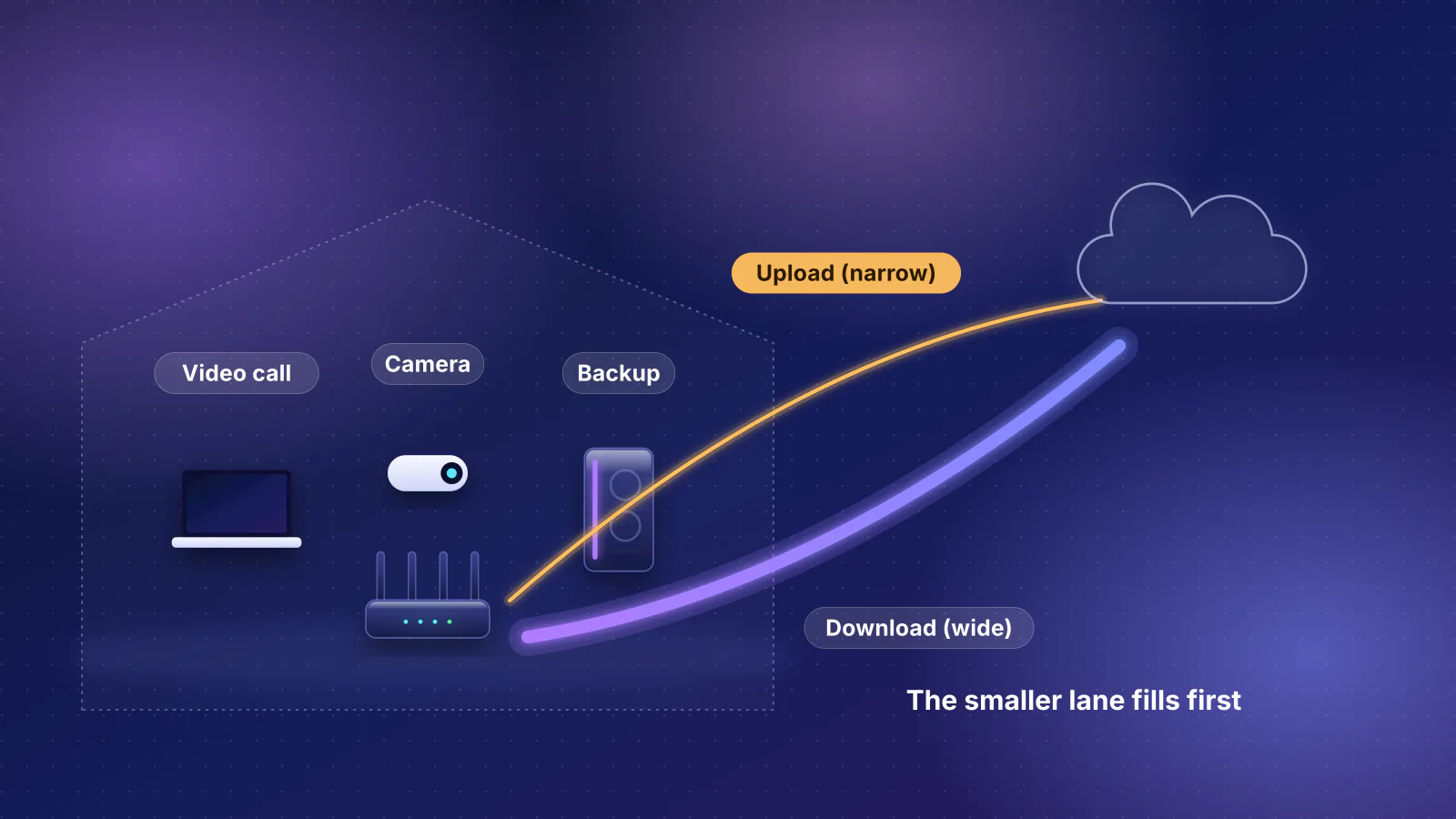
- Download speed doesn't separate them; upload does. On Spectrum's standard cable tiers the typical upload is 23 Mbps (Internet 100 and 500) or 40 Mbps (Internet 1 Gig), by Spectrum's own disclosure and label. The fiber providers publish uploads close to their downloads: AT&T lists 946.9 Mbps typical upload on its 1 Gig label.
- The latency figures are lower on fiber, but they aren't measured the same way. Spectrum's labels say 19 ms; AT&T's 1 Gig label says 10.7 ms; Quantum Fiber's disclosure gives 2.6 to 5.2 ms by tier; GFiber says "typically 13 milliseconds". The providers describe their methods differently, and not all say where they measure to, so use them as a rough guide, not a ranking.
- The terms are closer than the technology. All four list unlimited data or no data caps on the plans we read, and none requires an annual contract. The equipment rules differ more, and matter if you want your own router.
- Who owns whom changed in 2026. Charter (Spectrum) announced on August 20, 2026 that it had completed its transaction with Cox, and AT&T announced on February 2, 2026 that it had purchased substantially all of Lumen's Mass Markets fiber business; AT&T's own page says "Quantum Fiber is now part of the AT&T family".
- Choose fiber if uploads matter to you (several people on video calls, cloud cameras, backups, creating) and it reaches your address. If your home mostly streams and browses, Spectrum's cable is enough, and switching won't fix slow Wi-Fi.
- Check your own address, on each provider's checker and on the FCC's National Broadband Map, then read the label for the exact plan before you order.
This page compares cable and fiber for Arizona homes. The national comparison of fiber, cable, 5G and satellite by FCC measurements is in which internet type is best for gaming, and who the FCC's map lists city by city, with each provider's own-router rules, is in Phoenix internet providers and your own router. Provider pages here were read November 27, 2026.
Who sells cable and fiber in Arizona now
Two ownership changes this year affect which name is on the bill. Both are confirmed on the companies' own pages:
- Cox is now Spectrum. Charter announced on August 20, 2026 that it "has completed its previously announced transaction with Cox Communications" and "will continue to operate as Spectrum across all markets." Spectrum's standard service is cable: its fiber page says that for ordinary service "fiber runs all the way to the node, or central hub, outside of your neighborhood" and "your home may be connected by a coax cable".
- Spectrum Fiber is the exception: "in select areas, we offer Spectrum Fiber which delivers a 100% fiber optic connection directly to the home", with "Limited availability in Spectrum serviceable areas," according to the same page.
- Quantum Fiber is part of AT&T. AT&T announced on February 2, 2026 that it "has purchased substantially all of Lumen's Mass Markets fiber business", and AT&T's Quantum page says "Quantum Fiber is now part of the AT&T family". Quantum still sells its own plans on its Phoenix page, with "Limited availability. Service and speed in select locations only."
- AT&T Fiber is sold separately on AT&T's Phoenix page, which says "Limited availability. May not be available in your area" and "Plan speeds and availability may vary by address within Phoenix."
- GFiber lists Chandler, Mesa and Queen Creek among its cities, with Tempe under "Coming Soon".
None of these pages tells you whether a given street is served, and neither do we: availability is decided address by address. The address check below is how to find out. What the ownership changes mean for your equipment is covered in your own router with Spectrum and your own router with Quantum Fiber.
What the providers' own figures show
Since 2024 the FCC has required a Broadband Facts label for each home internet plan. The FCC's glossary defines typical upload speed as "the speed that data can be sent from a device to other devices" and typical latency as "the amount of time it takes for data to travel from one endpoint to another". Labels are shown when you order, and the FCC says providers must make each customer's label "easily accessible to the customer in their online account portal". Where a label wasn't readable from here, the table uses the provider's own performance disclosure, and says so.
| Provider and plan | Download | Upload | Latency | Where the figure comes from |
|---|---|---|---|---|
| Spectrum Internet 100 (cable) | 113 Mbps | 23 Mbps | 19 ms | Spectrum broadband disclosure |
| Spectrum Internet 500 (cable) | 572 Mbps | 23 Mbps | 19 ms | Spectrum broadband disclosure |
| Spectrum Internet 1 Gig (cable) | 1,045 Mbps | 40 Mbps | 19 ms | Broadband Facts label |
| Spectrum Internet 1 Gig, equal-speed version | 1,159 Mbps | 1,050 Mbps | 19 ms | Broadband Facts label; Spectrum says equal-speed tiers are offered "In certain locations" |
| Spectrum Internet 2 Gig | 2,056 Mbps | 1,002 Mbps | 19 ms | Spectrum broadband disclosure; "In certain locations" |
| AT&T Fiber 300 | 396.1 Mbps | 385.4 Mbps | 10.3 ms | AT&T performance page: 24-hour medians from its own gateway to the closest AT&T internet access point |
| AT&T Fiber 500 | 657.6 Mbps | 643.4 Mbps | 11.5 ms | AT&T performance page |
| AT&T Internet 1000 (Fiber 1 GIG) | 999.6 Mbps | 946.9 Mbps | 10.7 ms | Broadband Facts label (same figures on the performance page) |
| AT&T Fiber 5 GIG | 4,955.0 Mbps | 5,046.3 Mbps | 10.4 ms | AT&T performance page |
| Quantum Fiber 500 Mbps | 527.6 Mbps | 531.7 Mbps | 5.2 ms | Quantum service disclosure: peak-period (7 to 11 p.m.) medians |
| Quantum Fiber 1 Gbps | 1,087.4 Mbps | 1,070.6 Mbps | 2.9 ms | Quantum service disclosure |
| Quantum Fiber 3 Gbps | 3,382.4 Mbps | 3,208.3 Mbps | 2.6 ms | Quantum service disclosure |
| Quantum Fiber 8 Gbps | 8,110.9 Mbps | 8,056.2 Mbps | 2.8 ms | Quantum service disclosure |
| GFiber Core 1 Gig | "Up to 1 Gbps (1,000 Mbps)" each way through a wired connection; GFiber publishes its label values as images we couldn't read | "typically 13 milliseconds" | GFiber plan overview and Mesa page | |
Three notes on reading it:
- The fiber uploads come close to the downloads; Spectrum's standard cable uploads don't. On Spectrum's Internet 1 Gig label the upload is about 4% of the download (arithmetic: 40 ÷ 1,045). The two Spectrum rows with large uploads are tiers Spectrum offers only in certain locations, and the pages we read don't say which technology carries them.
- The latency column isn't a fair race. Spectrum says its results are "measured at the modem" by a third party with a method similar to the FCC's Measuring Broadband America, without naming the test server; AT&T measures from its gateway to the closest AT&T internet access point; Quantum measures "the round-trip time from the consumer's home to the closest measurement server and back" at peak times, and separately says customers should expect round-trip latency "to most internet sites" of 3 to 15 ms; GFiber's Mesa page gives 13 ms without a method, and its blog gives 14.8 ms from Ookla data for the second half of 2025, measured as "the median latency across multiple off-network servers". A provider that measures to a farther server reports a higher number for the same network. The FCC doesn't standardize the method, as what the broadband label says about latency explains.
- None of these is latency under load, the delay while someone in the house is uploading. Our summary of the FCC's 2022 measurements by technology shows that's where cable and fiber differed most, and it's mostly a queue you can test and often shorten at home.
Quantum's disclosure says its tables give medians "for download, upload, and latency", but both of its speed tables are headed "Download Speed". The upload column above is the second table, the one without latency; that it holds the upload figures is our reading, not a label on the page. Quantum's Phoenix page itself describes its plans as "symmetrical speeds on most plans", with the 2 Gig tier at up to 2 Gig download and up to 1 Gig upload.
Why cable sends so much less than it receives
A cable line carries both directions on one coaxial cable, split by frequency. CableLabs, which writes the DOCSIS standards, says "the lower band is dedicated to upstream traffic", and in the traditional sub-split that band is "5 MHz to 42 MHz", with downstream from 54 MHz up to 1.2 or 1.8 GHz. Widening the upstream band (mid-split, 5 to 85 MHz; high-split, up to 204 MHz) means network upgrades such as replacing amplifiers, which CableLabs lists among the changes needed. The standards allow more than most plans use: CableLabs gives DOCSIS 3.1 "upstream speeds of up to 1 Gbps" and DOCSIS 4.0 "up to 6 Gbps upstream capacity", and notes that "deployed network performance will vary across implementations." Spectrum's own fiber page puts it plainly: traditional cable "cannot currently support symmetrical upload/download speeds."
Fiber plans are often sold with matching speeds, as the fiber rows in the table above show, though the provider still sets each plan. For the full explanation, what calls, cameras and backups need, and how to tell whether upload is your bottleneck, see upload speed explained.
What the gap means in practice, as illustrative arithmetic at a steady full rate: sending 50 GB (a large photo library to a cloud backup) takes 50 × 8,000 ÷ 23 = about 17,400 seconds, nearly 5 hours, at Spectrum's 23 Mbps typical upload, and 50 × 8,000 ÷ 946.9 = about 420 seconds, 7 minutes, at AT&T's 1 Gig typical upload. For those 5 hours, every video call in the house shares what's left.
Data, contracts and equipment
From each provider's own label, plan page or disclosure, read November 27, 2026:
| Provider | Data | Contract | Equipment |
|---|---|---|---|
| Spectrum (cable) | "All Spectrum Internet plans as of September 16, 2026 include free unlimited data"; labels list "Unlimited" | "No contracts"; the 1 Gig label lists a $0.00 early termination fee and a 12-month introductory rate | Phoenix and Tucson guide (November 2026): "Modem or gateway lease, if applicable" at "No Charge"; Panoramic WiFi $10 a month, included with 1 Gig and 2 Gig |
| Spectrum Fiber | Not stated on the fiber page | "'No annual contract' means no minimum term period requirement and no early termination fees" | An ONT that "Spectrum provides this device free of charge"; "You will still need a router or gateway" |
| AT&T Fiber | 1 Gig label: "Unlimited". AT&T's machine-readable label file lists 1.5 TB on two low-speed fiber plans (Internet 5 and Internet 50), so read the label for yours. | No contract required; $0.00 early termination fee (1 Gig label) | Phoenix page comparison table: "Equipment fee included"; label: $150.00 if the gateway isn't returned |
| Quantum Fiber | Quantum "does not currently place data usage limits on fiber internet customers" | "no annual contract" (Phoenix page) | Wi-Fi 7 equipment "at no monthly charge for initial period" |
| GFiber | "No data caps" | "No contracts" | Router included (Wi-Fi 6E on Core 1 Gig); "all hardware must be returned within 60 days of cancellation" |
Prices change with address, promotions and bundles, so compare the label for the plan you'd order rather than an advertised headline. Two things to look for on it: whether the price is an introductory rate, and what it becomes afterwards. Spectrum's 1 Gig label, for example, gives $70.00 as "a 12 month introductory rate" with "The post-introductory rate is $105", matching the $105 standard rate in the Phoenix and Tucson guide. AT&T's 1 Gig label lists $90.00 and says it "does not include discounts". GFiber's Mesa page lists Core 1 Gig at $70 a month and says it has no promotional prices. Quantum's Phoenix page shows new-customer prices below its regular ones, some with AutoPay and paperless billing discounts, so read its label when you order.
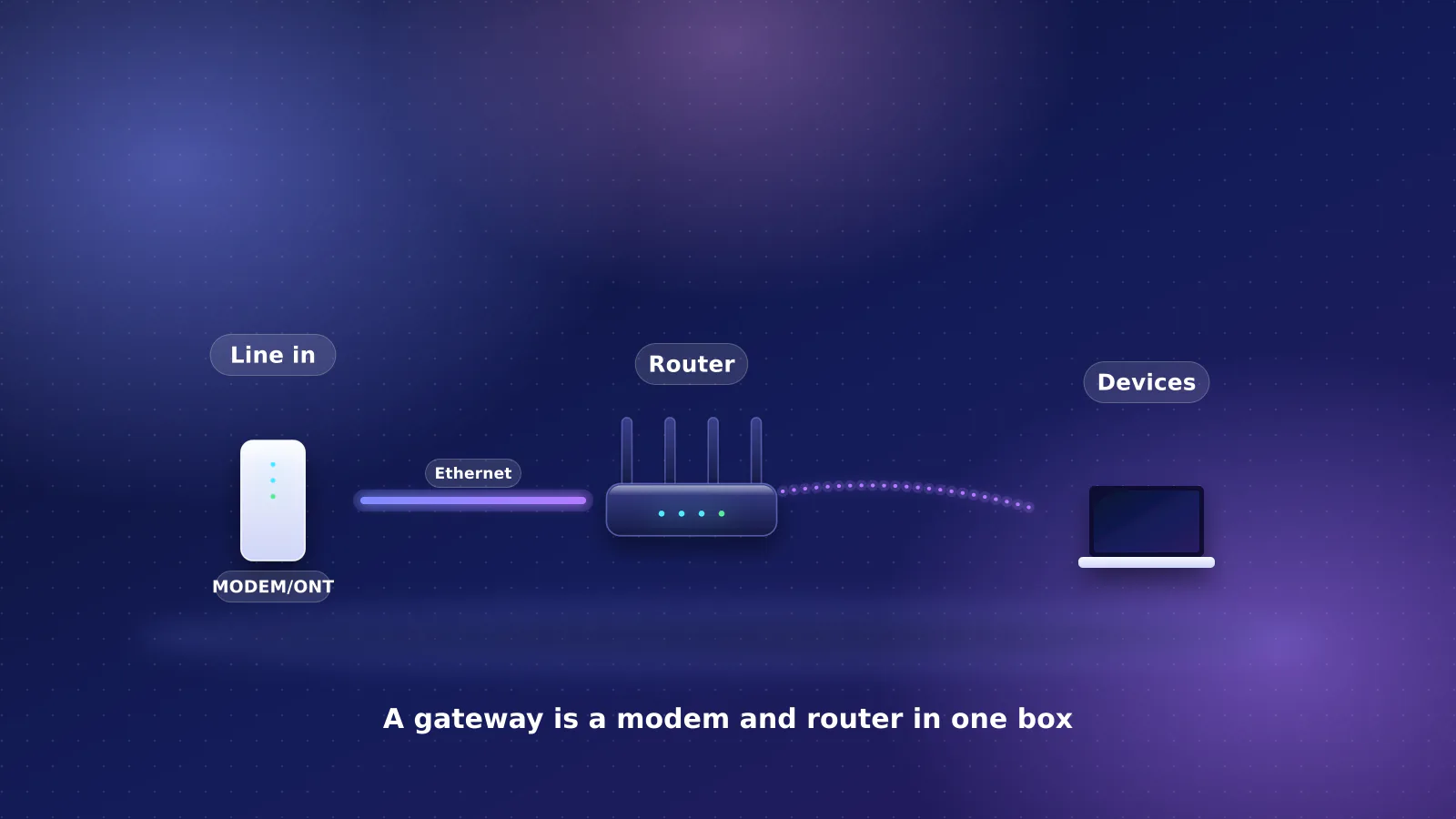
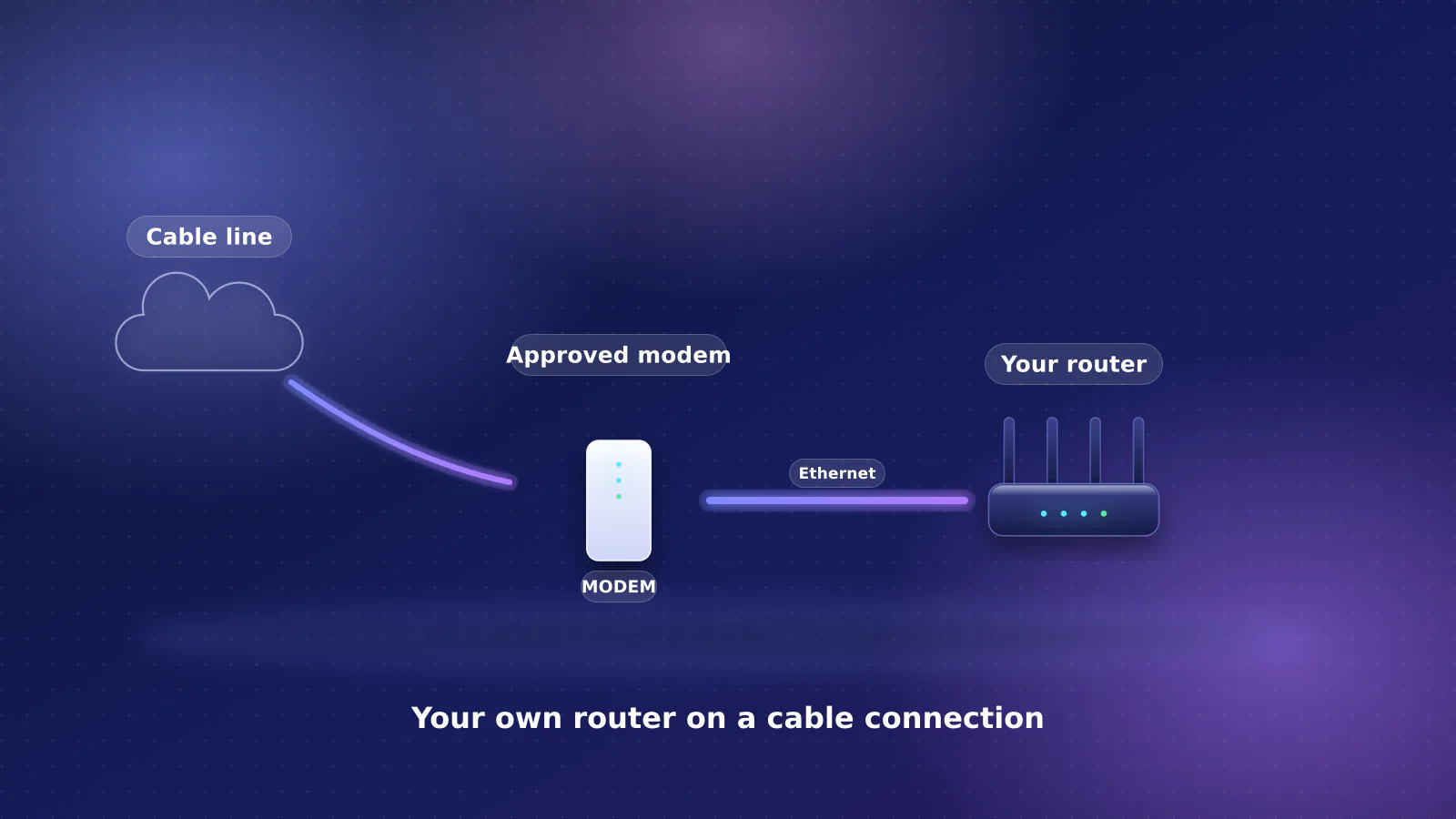
The equipment that stays on the wall decides how easily you can run your own router: on Spectrum cable, a modem from Spectrum's list on non-symmetrical tiers; on GFiber, your router plugs into the Fiber Jack; on Quantum, the SmartNID keeps routing and your gear runs as an access point; on AT&T Fiber, the gateway stays and uses IP passthrough. The details are in the Phoenix providers table, Spectrum's modem list and AT&T Fiber's gateway and IP passthrough.
How to check what reaches your address
- Run each provider's own address check. Spectrum's fiber page, AT&T's Phoenix page and GFiber's Mesa page each have a check-availability link, and the provider's check is what decides whether you can order. It's the only reliable answer for fiber, which AT&T, Quantum and Spectrum all describe as limited availability.
- Cross-check on the FCC's National Broadband Map. Enter your street address in "Search by Address". The FCC says the location shows which providers report offering broadband there, the types of service, and "the maximum advertised download and upload speeds they each offer." It's the providers' own filing, it runs months behind and it shows no prices. A fiber provider you just heard about may not appear yet, and a listing isn't a promise. How to check your address on the map covers the map's dates and how to challenge a wrong listing.
- Read the label for the exact plan before you order: typical upload, latency, data, the price after any introductory period, and equipment fees. The FCC says labels should appear "at any point of sale, including online and in stores".
Before you switch: test the connection you have
If you're on Spectrum cable now and something feels slow, find out which part is slow before you change providers. On a computer wired to the router, compare your upload with the label's typical upload, then watch latency while the upload runs. Upload close to the label but latency jumping during the upload is bufferbloat, which smart queue management on your own router can often fix without a new plan (how to test for bufferbloat). Upload close to the label and steady latency, yet calls still struggle when the house is busy, means the uploads at that moment add up to more than the plan sends, and that is a real reason to look at fiber or an equal-speed tier.
Cable or fiber: the decision table
Assuming both reach your address, by what your household actually does:
| Your household | Lean toward | Why, from the providers' figures | Check first |
|---|---|---|---|
| Several people on video calls, cloud cameras, backups, uploading video | Fiber, or a Spectrum equal-speed tier where offered | Fiber uploads in the hundreds or thousands of Mbps against 23 to 40 Mbps on Spectrum's standard tiers | The label's typical upload; add up what you send at once with the figures in how much upload each use needs |
| Gaming | Fiber if it's there; cable works if latency stays low under load | Fiber's quoted latency is lower, though measured differently; in the FCC data summarized in our gaming comparison, the bigger difference was under load | Loaded latency on your current line; whether the provider's box can give you an open NAT (Arizona providers and CGNAT) |
| Budget first | The cheapest tier whose label upload covers your calls | Spectrum's Internet 100 and 500 list the same 23 Mbps upload, so the higher tier buys download only (the Phoenix and Tucson guide lists Internet 100 under limited-eligibility offerings) | The price after any introductory period, and equipment charges, on the label |
| You want to own your router | GFiber or Spectrum cable are the simplest | GFiber: router into the Fiber Jack. Spectrum: your router behind its modem, or your own modem on non-symmetrical tiers | On Quantum and AT&T Fiber the provider's box keeps routing; plan for access-point mode or IP passthrough |
| Mostly streaming and browsing | Keep what you have | Streaming runs on download, which every plan above provides; see internet speed for streaming | Whether the problem is Wi-Fi in the room rather than the line |
When switching is worth it, and when to get help
Switching from cable to fiber is justified when the uses that matter in your home at the same moment need more upload than your label's typical upload, or when latency under load stays high after you've tried smart queue management. It isn't justified to fix weak Wi-Fi: a faster line arrives at the same router, and coverage in block and stucco homes is a layout question, covered on our Phoenix metro planning page. Buy nothing new for the switch itself until you know what the provider installs and whether your current router will sit behind it.
A fiber install can put the provider's terminal in a different place from your old cable outlet. If the router then needs Ethernet to another room, or the box ends up somewhere you'd rather it wasn't, ask the provider about placement at the install. When the job needs cable run through walls or an attic, RouterHaus can connect you with a licensed contractor who does the work on site; ask for a network plan.
Frequently asked questions
Is fiber faster than cable in Phoenix?
On download, not by much at the same tier: Spectrum's 1 Gig label lists 1,045 Mbps typical download and AT&T's 1 Gig label 999.6 Mbps. On upload, yes: 40 Mbps typical on Spectrum's standard 1 Gig cable tier against 946.9 Mbps on AT&T's 1 Gig fiber label. Check the labels for your own address.
Does Spectrum have fiber in Arizona?
Spectrum's fiber page describes Spectrum Fiber as a 100% fiber connection directly to the home in select areas, with limited availability in Spectrum serviceable areas, and its disclosure lists equal-speed tiers in certain locations. Its standard service runs fiber to a neighborhood node and coax to the home. Use Spectrum's address check to see what your home can get.
Is Quantum Fiber the same as AT&T Fiber now?
Same owner, separate services for now. AT&T announced on February 2, 2026 that it had purchased substantially all of Lumen's Mass Markets fiber business, and its Quantum page says Quantum Fiber is now part of the AT&T family, but Quantum still sells its own plans and equipment on its Phoenix page, and AT&T sells AT&T Fiber separately.
Do any of these providers have data caps?
Not on the plans we read: Spectrum says all its plans include unlimited data as of September 16, 2026; AT&T's 1 Gig label lists unlimited data; Quantum says it doesn't currently place data usage limits on fiber customers; GFiber says no data caps. AT&T's label file lists 1.5 TB on two older low-speed fiber plans, so check the label for your plan.
Why is my cable upload so low?
Cable gives upstream traffic a small, low band of frequencies, 5 to 42 MHz in the traditional split, and plans are built around it. Spectrum's own fiber page says traditional cable cannot currently support symmetrical speeds. If upload is your limit, compare the typical upload line on fiber labels at your address.
Sources
Read on November 27, 2026. Spectrum's label and disclosure are national documents, not labels served for an Arizona address; the Phoenix and Tucson guide is Arizona-specific. AT&T's 1 Gig label was opened by its plan identifier and shows no date; AT&T's performance page and Quantum's disclosure give no measurement dates. GFiber's label values are published as images that couldn't be read for this article.
- Spectrum Broadband Facts: Internet 1 Gig (40 Mbps typical upload) and Internet 1 Gig (1,050 Mbps typical upload)
- Spectrum: Residential broadband internet services and pricing (rev. November 19, 2026)
- Spectrum: Phoenix & Tucson product and pricing guide, November 2026 (PDF, cox.com)
- Spectrum on cox.com: Internet plans (unlimited data FAQ) and Spectrum Fiber
- Charter: Charter and Cox Communications complete transaction (August 20, 2026)
- AT&T: completes acquisition of Lumen's Mass Markets fiber business (February 2, 2026) and Quantum Fiber is now part of the AT&T family
- AT&T: Home internet in Phoenix, AZ and AT&T launches simple fiber plans (June 3, 2026)
- AT&T: Broadband Facts, Internet 1000 (Fiber 1GIG), AT&T broadband performance (speeds and latency by fiber tier) and Broadband Facts machine-readable files
- Quantum Fiber: Fiber internet in Phoenix, AZ, Internet service disclosure and Broadband information label
- GFiber: Mesa, AZ plans, city list, Core 1 Gig plan overview, network performance and low latency (May 27, 2026) and broadband labels
- CableLabs: Band splits, splitting our way to 10G, DOCSIS 3.1 and DOCSIS 4.0 technology
- FCC: Glossary of terms used for consumer broadband labels and Broadband labels
- FCC Broadband Data Collection help: How to use the FCC's National Broadband Map