The short version
- A wiring quote is four numbers: materials (cable, jacks, plates, patch panel), labor hours, the contractor's hourly rate, and equipment (gateway, switch, access points). Ask for each one separately and you can check them; a single lump sum can't be checked.
- Labor is the line that moves. The same drop takes far longer to fish through a finished wall than to pull through open studs. The worked example below assumes 1.5 to 4 hours per drop for a retrofit against 0.75 to 1.5 for new construction, for the same 14 drops.
- The wage is not the rate. The Bureau of Labor Statistics puts the median wage for telecommunications equipment installers in the Phoenix-Mesa-Chandler metro at $29.90 an hour (May 2025). Employers' benefit costs add about 45% on top of wages for construction and maintenance occupations. A contractor's billed rate also has to cover overhead and profit, and we found no published figure for that, so this article gives you a way to back the rate out of a quote rather than a number.
- Equipment is the part you can price exactly. For the example home, a gateway, PoE switch, small second switch and two ceiling access points come to $527.95 (TP-Link Omada, dual-band) or $910 (UniFi, with 6 GHz) at manufacturer store prices in the RouterHaus catalog (checked October 20, 2026).
- For the worked example, a 3,000 sq ft two-story new build with 14 drops, materials, labor at employer cost and equipment add up to $1,576 to $3,689. That's a floor for checking quotes, not a price: the contractor's overhead and profit, permits, conduit and tax come on top.
- In Arizona, a job of $1,000 or more, labor and materials together, falls outside the handyman exemption and needs a contractor licensed by the Registrar of Contractors, as does any job that needs a local building permit or is part of a larger project such as building the house. A separate exemption covers internet, TV and phone providers' own installers.
This article is about the money. For what to wire in the first place, see our suggested drops by room; this article uses that table and doesn't repeat it.
The worksheet: what a quote is made of
Every structured-wiring quote, however it's presented, is built from the same pieces:
Total = materials + (labor hours × billed hourly rate) + equipment + permits and other fees
Each input comes from one of three places, and the worksheet says which so you know how far to trust it:
- Sourced: a published figure with a citation, such as federal wage data.
- Catalog: a manufacturer's store price from the RouterHaus catalog, with the date it was checked.
- Assumption: a figure RouterHaus chose to make the arithmetic concrete, with the reasoning. Replace each one with a number from a local quote or supplier.
| Line | How to calculate it | Where the number comes from |
|---|---|---|
| Drop count | Count every cable run to the closet, by location and cable category | Your plan (start from the drops-by-room table) |
| Cable footage | Drops × average run length, including service loops at each end | Assumption until the installer measures the plan |
| Cable cost | Footage × price per foot (a 1,000 ft box price ÷ 1,000), per category | Assumption; replace with a supplier's price |
| Termination hardware | Drops × (jack, wall plate, mounting bracket, patch-panel port, label) | Assumption; replace with a supplier's price |
| Closet hardware | Patch panel, wall rack or structured media enclosure, cable management | Assumption; replace with a supplier's price |
| Labor hours | Drops × hours per drop, plus closet build-out | Assumption; ask each installer for their hour estimate |
| Billed hourly rate | From the quote, or quoted labor ÷ labor hours | The quote. A local wage is the floor, not the rate (see below) |
| Equipment | Gateway + switch(es) + access points, sized to your drops | Catalog prices |
| Permits and fees | As your city or county charges | Your building department |
What moves the price
These are the decisions that change each line of the worksheet. None of them has a published price; the point of the table is which line each one moves, so you know what to ask about.
| Cost driver | Lines it moves | What to know |
|---|---|---|
| New construction vs retrofit | Labor hours, exclusions | With open studs, cable is pulled before insulation and drywall (rough-in) and terminated after paint (trim-out). In a finished home every run has to be fished through closed walls, top plates and floors, and wall or ceiling holes may need patching that the low-voltage quote doesn't include. |
| Drop count | Everything per drop, plus switch ports | Each drop is a separate home run to the closet. More drops also means more switch ports, though only the drops you use on day one need to be patched in. |
| Cable category | Cable cost, some labor | Cat6a supports 10 Gbps over full-length runs; Cat6 is enough for 1, 2.5 and 5 Gbps on typical home runs (the comparison is here). Standard Cat6a is thicker, so it fills boxes, conduit and patch panels sooner. |
| Ceiling access point drops | Labor hours, equipment | A ceiling drop ends at a jack or plug where the access point mounts, and the switch that feeds it needs PoE ports and enough power budget. Pulling a spare ceiling drop costs a run now and saves a fished run later. |
| Conduit | Materials, labor hours | Conduit from the utility entry to the closet, and between floors, lets you or your provider add cable later. It's a separate line: ask for its size, route and whether a pull string is left in it. |
| Patch panel and terminations | Termination and closet hardware, labor | Every run should end on a jack at the outlet and a numbered patch-panel port in the closet. Ask what each run ends on at both ends, including at ceiling access point locations. |
| Testing and certification | Labor hours, sometimes a separate line | Fluke Networks, which makes cable testers, separates verification (is it wired correctly), qualification (will it carry a given speed) and certification, which it says is "required by cabling manufacturers to receive a warranty". Ask which one you're getting and for the results. |
| Cable quality | Cable cost | Fluke says copper-clad aluminum (CCA) cables are "non-standards compliant" and often lack a valid UL safety listing, and that their higher resistance means more heat and less power at the far end, which matters for PoE. Ask for the cable's maker, model and solid copper conductors. |
| Permits and licensing | Fees, who can do the work | Rules vary by state and city. Arizona's are below. |
| Equipment scope | Equipment | Some quotes include a switch and access points; many cover cable only. Price equipment separately so quotes compare like with like. |
Labor: hours times a local rate
Labor is hours multiplied by what the contractor bills per hour. Neither number is published for home wiring, but the rate has a sourced floor: what the technician is paid.
What installers are paid
The Bureau of Labor Statistics' Occupational Employment and Wage Statistics (OEWS) program publishes wages by occupation and area. Two of its occupations are the closest matches for home network wiring. The closest is "Telecommunications Equipment Installers and Repairers, Except Line Installers" (49-2022), whose BLS definition says they "may install communications equipment or communications wiring in buildings". Some electricians (47-2111) also do low-voltage work alongside the power wiring in a new build.
| Occupation and area | Employed | 25th percentile | Median | Mean | 75th percentile |
|---|---|---|---|---|---|
| Telecom equipment installers (49-2022), U.S. | 140,920 | $24.92 | $30.72 | $32.93 | $39.27 |
| Telecom equipment installers (49-2022), Phoenix-Mesa-Chandler | 2,390 | $20.00 | $29.90 | $31.84 | $43.47 |
| Electricians (47-2111), U.S. | 757,220 | $23.76 | $30.38 | $34.37 | $40.36 |
| Electricians (47-2111), Phoenix-Mesa-Chandler | 17,240 | $23.51 | $29.43 | $30.95 | $37.05 |
Three limits on these figures. BLS says OEWS wages are "straight-time, gross pay, exclusive of premium pay" and "do not include ... employer costs of nonwage benefits". The survey "does not cover the self-employed", so owner-operators aren't in these figures. And BLS gives the Phoenix mean wage for 49-2022 a relative standard error of 9.7%, and the Phoenix employment figure one of 27.6%, so treat the Phoenix figures as approximate. The occupation is also mostly provider technicians: nationally, BLS counts 91,770 of the 140,920 in the telecommunications industry and 18,850 at building equipment contractors.
What a worker costs the employer
On top of wages, employers pay for benefits, such as paid leave and legally required benefits. BLS measures this in its Employer Costs for Employee Compensation survey. For June 2026, among private industry workers:
| Group | Total compensation | Wages and salaries | Wages as share of total | Total ÷ wages |
|---|---|---|---|---|
| All private industry workers | $46.89 | $32.82 | 70.0% | 1.43 |
| Natural resources, construction and maintenance occupations | $47.80 | $32.88 | 68.8% | 1.45 |
| Installation, maintenance and repair occupations | $49.01 | $33.61 | 68.6% | 1.46 |
| Construction industry | $51.96 | $36.13 | 69.5% | 1.44 |
Applied to the Phoenix median for 49-2022, that's about $29.90 × 1.45 = $43.36 an hour of employer cost (RouterHaus's calculation; the ratio is an average for broad groups, not a figure for cabling contractors).
Why the billed rate is higher, and how to check it
The rate on a quote also has to pay for time that isn't billed (driving, estimating, callbacks), the vehicle, tools and test equipment, licensing, bonding and insurance, the office, and profit. We found no published figure for how much that adds for residential low-voltage contractors, so we don't apply one. Instead, use the quote itself:
- Implied hourly rate = labor on the quote ÷ the installer's labor-hour estimate. If the quote is one price per drop, first subtract your materials estimate per drop.
- Multiple of the local wage = implied hourly rate ÷ the local median wage from the table above. It should be well above the 1.45 employer-cost ratio, since overhead and profit come on top. Compare the multiple across your quotes rather than against a rule of thumb.
- Hours per drop = labor-hour estimate ÷ drop count. This is where new-construction and retrofit quotes differ most, and where an unusually low figure can mean a step (testing, labeling, patch-panel termination) is missing.
Worked example: a 3,000 sq ft two-story home
A 3,000 sq ft home on two floors with drywall interior walls and a network closet near the middle of the ground floor. The coverage rule in our methodology (about one access point per 1,800 sq ft with drywall, at least one per floor) gives 3,000 ÷ 1,800 = 1.7, rounded up to two access points, one per floor. With block or stucco interior walls the rule gives three. Every assumption below is labeled; replace it with your own figure.
The drop schedule
Counts are taken from the low-to-middle end of our drops-by-room table, with Cat6a where that guide recommends it (access points, media wall, office) and Cat6 elsewhere.
| Location | Drops | Cable | Patched on day one? |
|---|---|---|---|
| Home office | 2 | Cat6a | Yes |
| Living room media wall | 2 | Cat6a | Yes |
| Ceiling access points (one per floor) | 2 | Cat6a | Yes, on PoE ports |
| Spare ceiling access point drop | 1 | Cat6a | No |
| Primary bedroom | 1 | Cat6 | Yes |
| Three other bedrooms | 3 | Cat6 | Yes |
| Garage | 1 | Cat6 | No |
| Exterior eaves (future cameras) | 2 | Cat6 | No |
| Total | 14 | 7 Cat6a, 7 Cat6 | 10 patched (2 access points, 8 outlets) |
Materials
- Average run length: 70 to 100 ft (assumption). Reasoning: about 1,500 sq ft per floor, so the far corners are a few tens of feet from a central closet; runs follow walls and framing rather than straight lines, upstairs runs add a floor-to-floor rise, and each run needs slack at the closet and the outlet. An installer working from your plan will measure this.
- Footage: 7 drops × 70 to 100 ft = 490 to 700 ft of each category, 980 to 1,400 ft in total.
- Cable price: Cat6 $0.20 to $0.45 per foot, Cat6a $0.40 to $0.90 per foot (assumption). We haven't sourced cable prices; these placeholders exist to show the arithmetic. Replace them with a supplier's 1,000 ft box price divided by 1,000 for the exact cable named in the quote.
- Cable cost: Cat6a 490 × $0.40 = $196 to 700 × $0.90 = $630; Cat6 490 × $0.20 = $98 to 700 × $0.45 = $315. Total $294 to $945. Cable comes in boxes, so an installer buying for this one job may charge for two 1,000 ft boxes (one of each category) even though the job uses less; at the same assumed prices that's $600 to $1,350. Ask whether cable is billed by the foot used or by the box.
- Terminations: $8 to $25 per drop (assumption) for a jack and plate at the outlet, a low-voltage mounting bracket, the patch-panel port and labels. 14 × $8 = $112 to 14 × $25 = $350.
- Closet hardware: $100 to $400 (assumption) for a 24-port patch panel and a small wall rack or structured media enclosure. A 24-port panel leaves room for this schedule plus later drops.
- Materials subtotal: $294 + $112 + $100 = $506 to $945 + $350 + $400 = $1,695.
Labor hours
- New construction: 0.75 to 1.5 hours per drop (assumption). Reasoning: each drop gets a bracket, holes through plates, a pull and labels at rough-in, then termination at both ends and a test at trim-out, over two site visits. We found no free published labor-unit figure for residential data drops, so ask each installer how many hours they've allowed. 14 × 0.75 = 10.5 to 14 × 1.5 = 21 hours.
- Closet build-out: 2 to 4 hours (assumption) to mount the panel, dress cables and patch the active ports.
- Total: 12.5 to 25 labor hours.
At the Phoenix median wage for 49-2022, those hours represent 12.5 × $29.90 = $373.75 to 25 × $29.90 = $747.50 of wages, or about $542 to $1,084 at the employer-cost ratio of 1.45 (RouterHaus's calculation). A contractor's labor line has to be higher than that, by the overhead-and-profit margin that only quotes reveal. Use the implied-rate check on each quote you get.
The same schedule in a finished home
For an existing home, assume 1.5 to 4 hours per drop (assumption). Reasoning: runs to the second floor can often come down from the attic, but ground-floor rooms in a two-story home sit under a floor system rather than an attic, so those runs have to be fished through walls and floors, and some will need a hole cut and patched. 14 × 1.5 = 21 to 14 × 4 = 56 hours, plus the same 2 to 4 hours in the closet: 23 to 60 hours, or $687.70 to $1,794 of wages at the Phoenix median ($997 to $2,601 at the employer-cost ratio). Runs routed through the attic may also be longer, which raises the cable line (see the routes a retrofit run can take). Drywall repair and painting are usually extra (see what quotes leave out).
Equipment
The schedule patches 10 cables on day one: two access points that need PoE and eight outlets. So the switches need at least 10 free ports between them after their uplinks. Two ways to do it from the RouterHaus catalog, building on the Home A setups in our mesh vs access point cost comparison (a 2,500 sq ft two-floor home that also needs two access points):
| Item | Omada, dual-band Wi-Fi 7 | UniFi, Wi-Fi 7 with 6 GHz |
|---|---|---|
| Gateway | TP-Link ER707-M2: $119.99 | UniFi Cloud Gateway Ultra: $142 ($129) |
| PoE switch | Zyxel XMG-105HP, 4 × 2.5 Gbps PoE++ and 1 × 2.5 Gbps, 70 W: $99.99 | UniFi Switch Flex 2.5G PoE, 8 × 2.5 Gbps PoE++: $219 ($199), plus its 210 W adapter for the full budget: $79 |
| Second switch for the outlets | NETGEAR GS308, 8 × 1 Gbps: $27.99 | UniFi Switch Flex Mini 2.5G, 5 × 2.5 Gbps: $54 ($49) |
| Access points | 2 × TP-Link EAP723: $279.98 | 2 × UniFi U7 Pro: $416 ($378) |
| Free ports after uplinks | 2 PoE ports for the access points, 8 for outlets (exactly enough) | 2 PoE ports for the access points, 9 for outlets |
| Total | $527.95 | $910 |
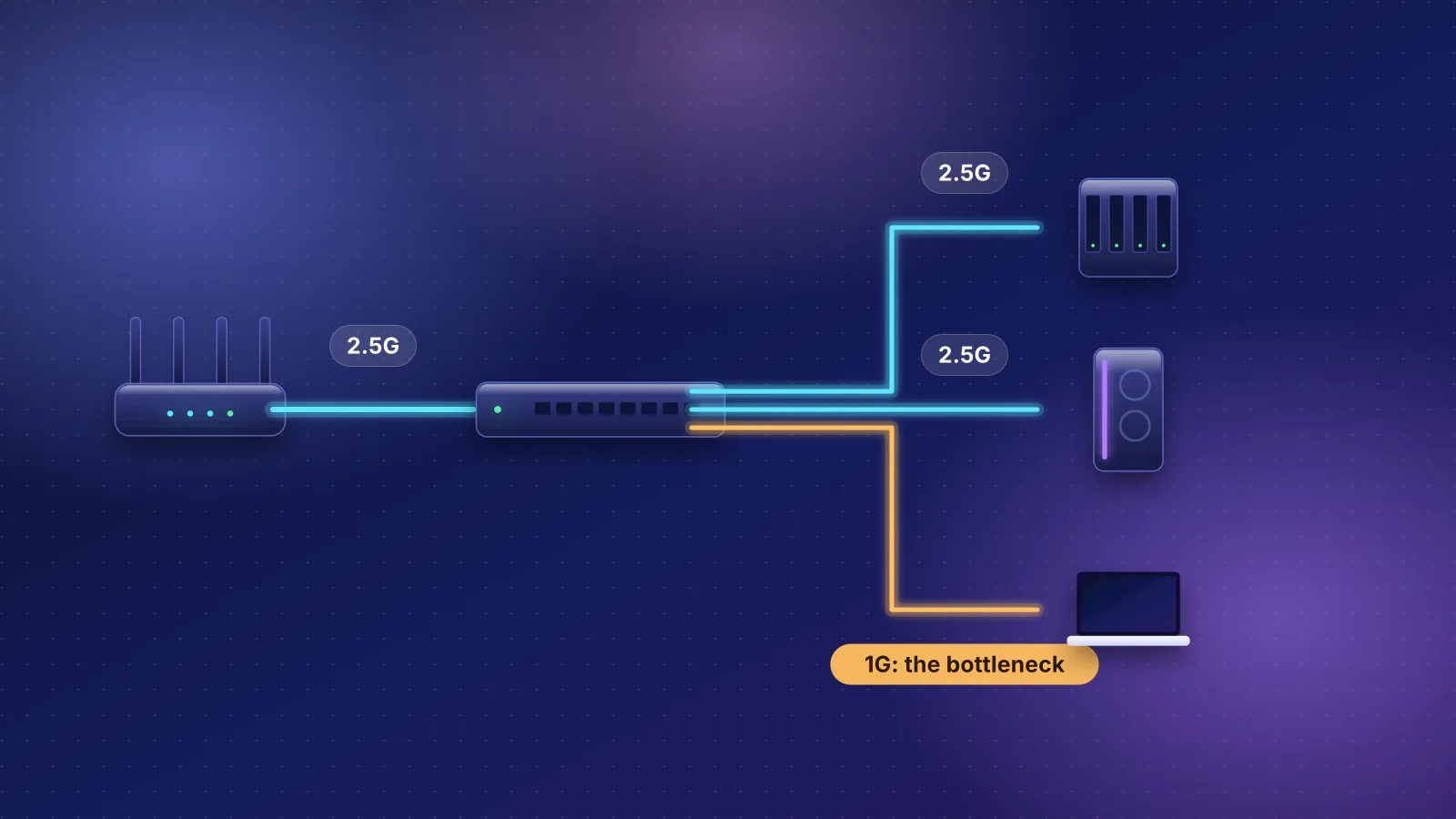
Both PoE switches fit two access points with the cautious per-class power sizing our PoE sizing section explains (2 × 30 W = 60 W, within the Zyxel's 70 W and the Flex's 196 W with its adapter). On plans up to 1 Gbps the gateways' LAN ports are no limit. On a faster plan, the Cloud Gateway Ultra's gigabit LAN ports cap the link to the switch at 1 Gbps, and the ER707-M2 needs its second 2.5 Gbps port (TP-Link labels it WAN/LAN) set as the LAN link; the $1,000 tier in our budget guide covers what else changes. The four unpatched drops (garage, eaves, spare ceiling drop) need ports only when you use them, and the eave drops will need PoE if cameras go there.
| Product | Internet port | Fastest LAN port | Maker's routing, plan or wired-speed figure | Price |
|---|---|---|---|---|
| TP-Link Omada ER707-M2 Gateway · no Wi-Fi |
2.5 Gbps | 1 Gbps | 2.4 Gbps | $119.99 Manufacturer store price, checked October 20, 2026 |
| Ubiquiti UniFi Cloud Gateway Ultra (UCG-Ultra) Gateway · no Wi-Fi |
2.5 Gbps | 1 Gbps | Not published | $142.00 Manufacturer store price incl. US store surcharge (list $129.00), checked October 20, 2026 |
Putting it together
| Line | Low | High | Basis |
|---|---|---|---|
| Materials | $506 | $1,695 | Assumptions |
| Labor hours | 12.5 | 25 | Assumptions |
| Labor at employer cost (Phoenix median wage × 1.45) | $542 | $1,084 | BLS wage and ECEC data; a floor, not a rate |
| Contractor overhead and profit on labor | Unknown: from your quotes | No published figure | |
| Equipment | $527.95 | $910 | Catalog prices |
| Permits, tax, conduit | Not estimated | Your building department and quotes | |
The materials, employer-cost labor and equipment lines add up to $1,576 to $3,689. That isn't what a contractor will charge; it's what the job costs before the contractor's overhead and profit, permits, conduit and tax. Its use is as a check: a quote far below it for the same scope is probably leaving something out, and the gap between it and a quote is what you are paying for overhead, profit and any assumption above that was too low.
How to read and compare quotes
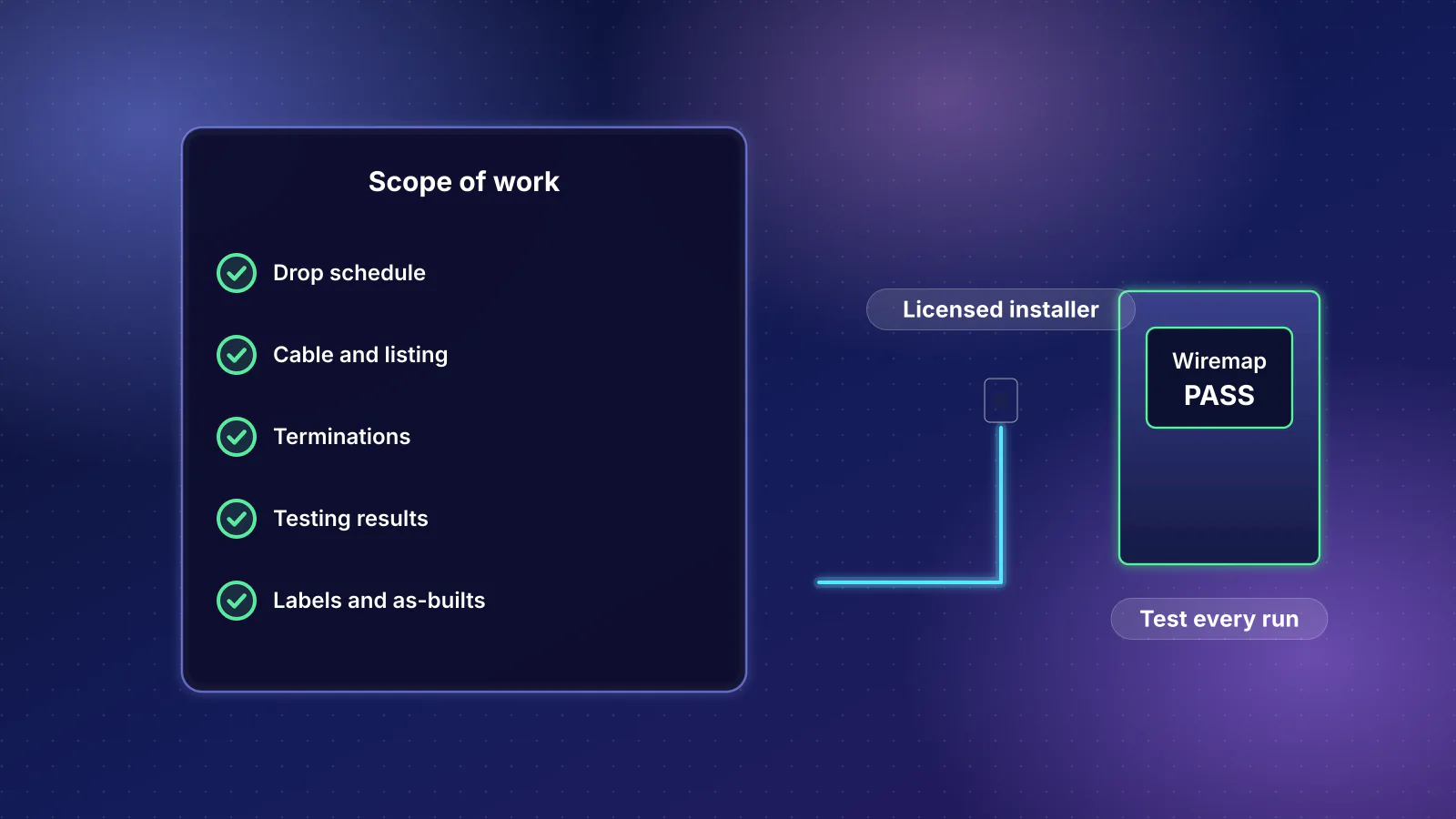
Quotes compare only when they describe the same job. Send each installer the same written drop schedule (our installer-hiring guide has a scope you can copy), then ask each one to price these lines separately:
- Drops by location and category, with the total count. Check it against your schedule line by line, including every ceiling drop.
- Cable maker, model and rating: category, solid copper conductors (not CCA), and the jacket rating the route needs (for example riser or plenum).
- Terminations at both ends: jacks and plates at outlets, a labeled patch panel in the closet, and what's at each ceiling access point location.
- Labor hours and hourly rate, or at least hours, so you can run the implied-rate check.
- Testing: verification, qualification or certification, and whether you get the results for every run at handover.
- Labeling: matching labels at both ends of every run, and a list that maps outlet to patch-panel port.
- Conduit: route, size and pull strings.
- Equipment: make and model of any switch, gateway or access point, priced separately from the cable work, so you can compare it with catalog prices or buy it yourself.
- Exclusions and permits, written out (next section), and the contractor's license number.
- Warranty: on workmanship, and whether a cable maker's system warranty applies (which, per Fluke, needs certification testing).
Builder packages work the same way. A builder's "low-voltage package" or "smart home package" is a quote with the lines bundled together. Ask the builder for the drop schedule, the cable category and the testing it includes, and compare that with what an independent low-voltage contractor would do for the same schedule during construction.
What quotes often leave out
- Drywall patching and paint. Retrofit installers may cut access holes and leave patching to you or another trade. Ask who closes the holes and to what finish.
- Equipment. Many wiring quotes stop at the patch panel. The gateway, switches and access points in the example add $527.95 to $910.
- The internet provider's installation. Bringing the provider's line into the house and installing its modem or fiber terminal is arranged with the provider, not usually the wiring contractor; the contractor's conduit just gives the line a path to the closet. Ask the provider what it will and won't do inside the home.
- Power in the closet. Outlets and any dedicated circuit are electrical work, usually by the electrician, not the low-voltage installer.
- Mounting and setup. Hanging the access points, configuring the network and setting up cameras may be extra, or may not be offered at all.
- Permits and inspection fees, where your city requires them.
- Firestopping where cables pass through fire-rated walls or floors, which local code may require.
For the equipment-side costs that hardware totals leave out, such as controllers and subscriptions, see costs the totals leave out in our budget guide.
Arizona: license and permit checks
- The handyman exemption is under $1,000. Arizona law (A.R.S. 32-1121(A)(14)) lets someone who isn't a licensed contractor do a project only if the aggregate contract price, including labor and materials, is less than $1,000, and the work is "of a casual or minor nature". The exemption doesn't apply when the work requires a local building permit, when it's part of a larger project or split into smaller contracts, or when the person advertises without saying "not a licensed contractor". The statute leaves certain plug-in electrical appliances out of the price, so equipment you buy may not count toward the $1,000. The wiring alone in the example is still over it (at least $506 of materials plus $542 of labor at employer cost, before the contractor's overhead and profit), and wiring a new build is part of a larger project, so an independent installer needs a license from the Arizona Registrar of Contractors (ROC). A separate exemption in the same section, paragraph 18, covers cable, satellite and telecommunications providers and their contractors when the work is limited to installing low-voltage cable and telephone, internet or data service. As we read it, that covers your provider's installer, not an independent installer you hire yourself, so ask anyone who says they don't need a license which exemption they rely on.
- The relevant classifications. The Arizona Administrative Code lists R-67 Low Voltage Communication Systems for residential work, C-67 for commercial work, CR-67 as the dual residential and commercial version, and R-11 Electrical. The R-67 scope lists alarm, telephone, sound, intercommunication, public address, and television or video systems and low-voltage signaling devices, among others; it doesn't use the words "data" or "computer network". Ask the contractor which classification they hold for this work, and look the license up on the ROC's website before you sign. The ROC's website blocked our automated requests, so we read the rule text in Cornell's Legal Information Institute copy of the code and checked it against an Internet Archive copy of the ROC's license classifications page saved October 19, 2026, which gives the same scopes.
- Permits are set locally. Whether a city requires a permit for low-voltage wiring in a house differs between jurisdictions, and we didn't find a City of Phoenix page that answers it. Ask your city's building department or the contractor, and remember the permit question also decides whether the handyman exemption can apply.
RouterHaus plans networks; we don't install cable, pull permits or give legal advice. If you're elsewhere, your state's contractor licensing board and your city's building department answer the same two questions.
Frequently asked questions
Why don't you give a price per drop?
Because the two biggest inputs, labor hours and the contractor's billed rate, aren't published for home wiring and vary with the house and the area. A per-drop number without its inputs can't be checked against your home. The worksheet lets you get hours and a rate from each quote and see where they differ.
Is Cat6a worth the extra cost in a new build?
Price the difference with the worksheet. Switching the worked example's 7 Cat6 drops to Cat6a adds 490 to 700 ft times the per-foot price difference; at the assumed prices that is $98 to $315, so replace those prices with a supplier's. Cat6a supports 10 Gbps over full-length runs, which is why it is the usual choice for access points, the media wall and the office. Standard Cat6a is thicker, so tell the installer early.
How can I tell if a quote's labor rate is reasonable?
Divide the quoted labor by the installer's hour estimate to get an implied hourly rate, then divide that by the local median wage from BLS. Employer benefit costs alone add about 45% to wages, and overhead and profit come on top, so the multiple will be well above 1.45. Compare the multiple and the hours per drop across quotes for the same drop schedule.
Does an installer in Arizona need a license for home network wiring?
For a job of $1,000 or more including labor and materials, any job that needs a local building permit, or work that is part of a larger project such as a new build, yes: the handyman exemption in A.R.S. 32-1121 doesn't cover it. A separate exemption covers internet, TV and phone providers and their contractors installing their own service. Otherwise, ask which Registrar of Contractors classification the contractor holds, such as R-67 or CR-67 Low Voltage Communication Systems, and look the license up before you sign. The R-67 scope doesn't name data networks, so if you're unsure whether a class covers the job, ask the ROC's license department.
Should the wiring quote include the access points and switch?
It can, but ask for equipment to be priced separately. Then you can compare it with manufacturer prices, choose the equipment yourself, and compare wiring quotes on the wiring alone.
Sources
Read on November 7, 2026, except the RouterHaus catalog, whose prices were checked October 20, 2026.
- U.S. Bureau of Labor Statistics: OEWS profile, Telecommunications Equipment Installers and Repairers, Except Line Installers (49-2022), May 2025 and Electricians (47-2111), May 2025 (wages and employment; figures retrieved through the BLS Public Data API)
- BLS: May 2025 metropolitan and nonmetropolitan area estimates (the Phoenix-Mesa-Chandler, AZ area)
- BLS: OEWS, 49-2022 occupation page (May 2023) (occupation definition)
- BLS: OEWS frequently asked questions (what OEWS wages include and exclude; self-employed not covered)
- BLS: Employer Costs for Employee Compensation, June 2026 and Table 4, private industry by occupational and industry group
- Arizona State Legislature: A.R.S. 32-1121, persons not required to be licensed (handyman exemption, paragraph 14; provider installers, paragraph 18)
- Legal Information Institute: Ariz. Admin. Code R4-9-103, residential contractor license classifications and R4-9-104, dual classifications (R-67, CR-67, R-11)
- Arizona Registrar of Contractors: License classifications (read through the Internet Archive's copy saved October 19, 2026, because the site blocked automated requests)
- Fluke Networks: Importance of cable verification, qualification and certification (January 23, 2019)
- Fluke Networks: Tips to identify copper clad aluminium (CCA) cables (January 18, 2017)
- RouterHaus catalog (components version 2026.10.20.3, products version 2026.10.20.5: manufacturer store prices and switch and access point specifications) and RouterHaus methodology (coverage rule and PoE sizing)